



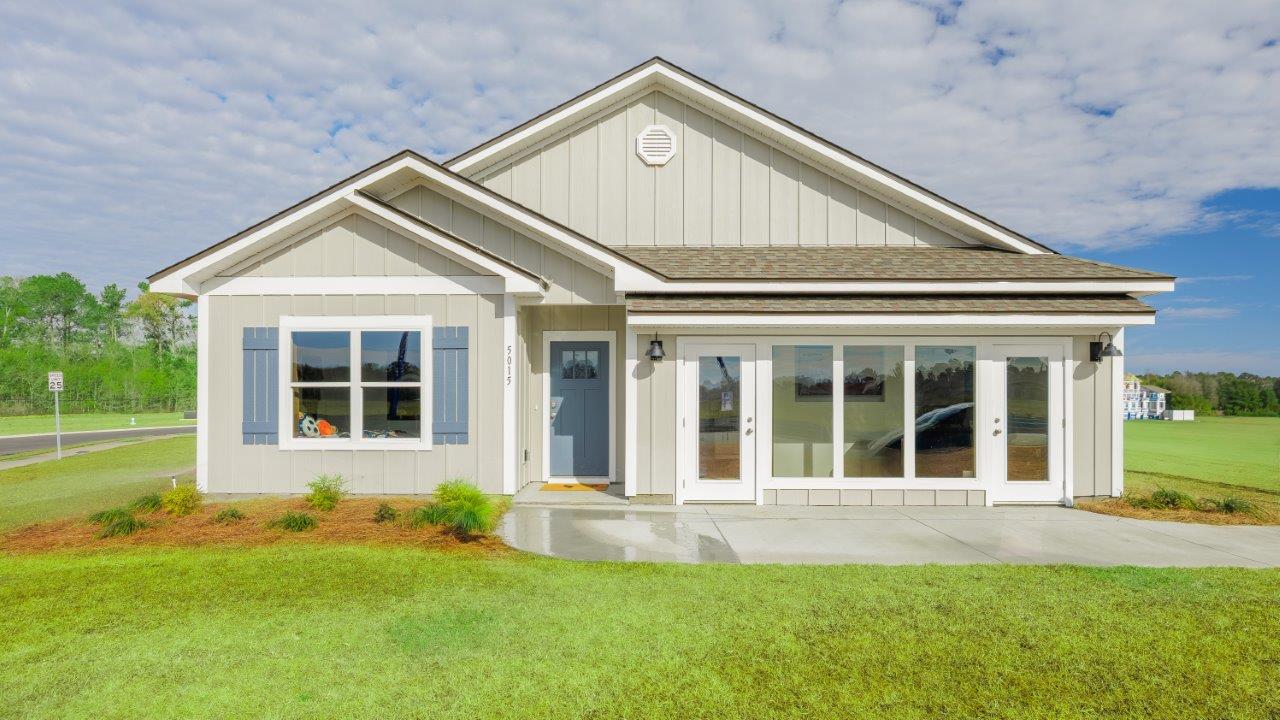
For many local buyers, the list price is not the real obstacle. It is the cash needed to actually get to the closing table. Down payment, closing costs, prepaids, and the immediate purchases that come with moving into a new home all land at once, and that stack of expenses is what keeps a lot of capable buyers on the sidelines longer than necessary.
This is especially true for first-time buyers who are mortgage-ready but cash-tight, and for Moody AFB families managing a relocation on a tight timeline. The monthly payment may fit the budget just fine, but pulling together everything needed before closing is a different challenge entirely. D.R. Horton addresses that challenge in some very practical ways, and understanding how can make homeownership feel a lot more reachable.
The most immediate advantages come from builder incentives like below-market rate offers, seller-paid closing costs, and rate buydowns. Beyond the financing side, included features like stainless-steel appliances and smart home technology reduce what you need to spend after closing. Location also plays a role, particularly for Moody AFB families where proximity to the base directly affects day-to-day costs.
There are also fair questions about build quality worth addressing honestly. D.R. Horton is a national brand that works with local crews and local management, and that distinction matters more than most buyers realize. This article walks through all of it, including the warranty protections that give buyers real written coverage after closing, so you can weigh the financial advantages against any concerns with a clear head.
Why This Option Matters When Cash to Close Is the Real Hurdle
Most buyers who get pre-approved for a mortgage feel ready. The monthly payment fits their budget, the numbers make sense, and they start browsing homes with real excitement. Then the full picture of what is needed at closing hits them, and suddenly that confidence takes a serious blow.
The mortgage payment is rarely the problem. What stops buyers is the stack of costs that have to be paid before they ever get the keys. Down payment, closing costs, prepaids like homeowners insurance and property taxes, and the immediate purchases that come with moving into a new home all land at roughly the same time. That is a lot of cash to have ready at once, and most buyers are not sitting on a large reserve.
According to the Consumer Financial Protection Bureau, closing costs range from 2 to 5 percent of the home purchase price, not including your down payment. On a $228,900 home, that puts closing costs somewhere between $4,578 and $11,445 before you factor in a down payment at all. For a first-time buyer or a military family managing a relocation, that range is not a small gap to bridge.
What makes this harder is that most buyers focus on finding the lowest-priced home rather than finding the path that requires the least cash upfront. Those are two very different goals. A $200,000 home with no seller concessions and a standard closing cost structure can actually require more out-of-pocket cash on day one than a $230,000 home where the builder is covering a significant portion of those costs. The sticker price does not tell the whole story, and buyers who understand this are in a much stronger position to make a smart decision.
The CFPB also points out that new homeowners often find things that need fixing or discover they need additional furniture to make the new home work for their family. That reality adds even more financial pressure right after closing, which means your available cash needs to stretch further than most buyers plan for. Shifting focus from purchase price to total cash required changes how you evaluate your options, and it is exactly where builder incentives can make a real difference.
How D.R. Horton Incentives Can Make Buying Possible Sooner
Being mortgage-ready but cash-tight is one of the most frustrating spots a first-time buyer can be in. You qualify for the loan, you can handle the monthly payment, but the upfront costs feel like a wall. Builder incentives are specifically designed to chip away at that wall, and D.R. Horton uses several of them to get buyers to the closing table faster.
Seller-paid closing costs are one of the most straightforward tools available. Instead of you writing a check to cover lender fees, title costs, and other charges at closing, the builder absorbs some or all of those expenses as part of the deal. This directly reduces how much cash you need on the day you sign. For a first-time buyer who has been saving for months, that kind of relief can mean the difference between buying now and waiting another year.
Rate buydowns work differently because they focus on your monthly payment rather than your upfront costs. A temporary buydown reduces a buyer's monthly mortgage payments during the first few years of the loan term, and builders often use them to help with affordability. They can last anywhere from one to three years, and once that period ends, your rate adjusts to the original agreed-upon rate for the rest of the loan. The practical benefit is real cash flow in those early years when new homeownership tends to come with unexpected costs.
This is where the difference between upfront affordability and monthly affordability becomes important. Some buyers are sitting on enough savings to handle closing costs but want a lower payment to stay comfortable month to month. Others have a strong income but limited liquid cash and need help getting across the finish line at closing. Knowing which situation applies to you helps you choose which incentive to prioritize.
Builder credits can also stretch further than most buyers expect. Depending on the community and the financing terms, credits may apply toward prepaids like your homeowner's insurance deposit, property tax escrow, and HOA-related startup costs. These are expenses that often catch buyers off guard because they sit outside the standard closing cost conversation. Stacking seller-paid closing costs alongside a rate buydown addresses both sides of the affordability equation at once, and NerdWallet notes that buydowns provide extra cash flow for new homeownership purchases like furniture and repairs. That matters a lot when you are moving into a brand-new home and still building your financial footing.
What Included Appliances and Features Save You After Closing
Closing day is not the finish line for spending. Many buyers get to the keys and then realize their new home needs a refrigerator, a microwave, window treatments, or a full kitchen setup before they can comfortably move in. That gap between what you budgeted and what you actually need can hit hard, especially when your savings have already taken a hit from closing costs and prepaids.
D.R. Horton communities typically include features that other builders charge extra for. Stainless-steel appliances, granite countertops, smart home technology, and energy-efficient fixtures are often standard, not upgrades. Each of those items carries a real price tag if you have to buy them separately after closing. A basic refrigerator alone can run $800 to $1,500 or more depending on the model. Multiply that across several missing appliances or finishes, and you are looking at thousands of dollars in purchases you may not have planned for.
The National Association of Home Builders notes that home buyers planning to purchase a brand-new house often cite "being able to select appliances, flooring, paint colors" and other design elements as a major factor in their decision. That kind of control and readiness is part of what makes new construction practical. When those elements are already included at the standard price, you are walking into a home that is genuinely move-in ready rather than move-in possible.
This matters most for first-time buyers who stretched their savings to get to closing. Having a home where the kitchen is already functional, the smart home system is already installed, and the finishes are already done gives you breathing room to rebuild your savings instead of draining them further.
It is also worth thinking about this from a comparison standpoint. A home priced slightly higher but fully loaded with included features can actually cost you less overall than a cheaper home where you are responsible for sourcing and paying for every appliance and upgrade on your own. The sticker price is only one part of the real cost of moving in.
NAHB also points out that newer construction is designed with modern households in mind, with builders planning for the increased number and type of electronics and appliances used by today's families. That means the infrastructure is already built to handle your actual lifestyle without needing costly retrofits or electrical upgrades, which is a practical financial protection that does not always get enough credit when buyers are comparing options.
Why This Can Work Well for Moody AFB Families and Local Relocations
Military relocations run on tight timelines. When a PCS order comes through, families often have weeks, not months, to find a place to live, get settled, and report for duty. That pressure alone makes predictability one of the most valuable things a home can offer, and new construction delivers exactly that. You know what you are getting, you know the timeline, and you are not competing in a bidding war over a resale home that may need immediate repairs.
Housing availability near Moody AFB has been a real challenge for servicemembers. The base's privatized housing leasing office has at times been accepting applications for a waiting list, which tells you something about demand in this area. When on-base options are not immediately available, families need reliable off-base alternatives, and that is where communities like Bemiss Springs and Phillips Place become worth paying attention to.
Bemiss Springs sits about 10 minutes from Moody AFB, which makes the daily commute manageable without adding unnecessary stress to an already demanding schedule. Phillips Place in Hahira is roughly 20 minutes out, which is still a reasonable drive for families who want a quieter setting without feeling disconnected from the base. These distances matter more than people often realize. A shorter commute means less fuel spending, more predictable morning routines, and more time at home, all of which add up in a real way over the course of a year.
Location is part of the affordability equation, not separate from it. When you factor in gas costs, vehicle wear, and time, a home that is 10 minutes from work is genuinely more affordable than a cheaper home that is 40 minutes away. For military households managing a budget on BAH, keeping those day-to-day costs in check supports the kind of financial stability that makes a move feel manageable rather than overwhelming.
New construction also removes a lot of the unknowns that can make off-base housing stressful. With a D.R. Horton home, you can walk in knowing what features are included, what the warranty covers, and what the builder's incentives look like. That level of clarity is hard to find in the resale market, especially when you are relocating from out of state and cannot easily tour homes in person. Families dealing with a PCS move are already managing enough variables, and having a home with defined features and known protections takes some of that weight off. For Moody AFB families who need to get settled fast and stay financially steady, that kind of predictability is worth more than most buyers initially give it credit for.
A Fair Way to Think About D.R. Horton Quality
Mixed opinions about D.R. Horton are everywhere online, and for buyers who are already nervous about making a big financial decision, those opinions can feel paralyzing. Some people share great experiences, others share frustrations, and it can be hard to know what to believe. The honest answer is that both sides are often telling the truth, and that is actually the most useful thing to understand.
Samantha Davis, a real estate professional, describes D.R. Horton like Walmart. You can walk into a Walmart in one city and have a completely different experience from a Walmart in another city, even though it is the same brand with the same name on the door. The product line may be consistent, but the execution depends heavily on the people running that specific location. D.R. Horton works the same way.
What most buyers do not realize is that D.R. Horton does not operate as one unified construction crew building homes from coast to coast. Each community is supported by local builders, local subcontractors, and local management teams. The quality of your home has a lot to do with the specific crew that built it, the local supervision in place during construction, and how well that particular community was managed from the ground up. A D.R. Horton home in one neighborhood is not automatically the same as one built across town or in another state.
This does not mean you should ignore concerns when you come across them. If buyers in a specific community are reporting consistent issues, that is worth paying attention to. But walking away from a home purely because of a bad review from a different city, or from a community built five years ago under a different management team, is not a fair way to make a decision.
The smarter approach is to evaluate each community on its own terms. Talk to people who have recently bought in that specific neighborhood. Ask your agent what they have seen firsthand from that build team. Visit the community, observe the construction quality in person, and ask the sales team direct questions about who is building and what their process looks like. Judging a D.R. Horton community by its own track record gives you far more accurate information than relying on generalized opinions about the brand as a whole. Fear-based decisions often lead to missed opportunities, while informed decisions lead to outcomes you can actually feel confident about.
The Warranty Protections That Help Lower the Risk
Buying a new construction home at an affordable price point can feel like a gamble, especially when you have read mixed reviews online. What actually gives you the power to move forward with confidence is understanding what is written in the warranty, not just what strangers are saying on a forum.
D.R. Horton's warranty structure is built in three layers, and each one covers a different window of time after closing.
- The first year covers workmanship and materials issues that impair the function of your home. This is the period where you are most likely to notice anything that was not finished correctly or installed properly, and having that coverage in writing means you can get those issues addressed without paying out of pocket.
- The second layer extends to two years and covers the systems inside your walls, specifically electrical wiring, heating and cooling ductwork, and plumbing systems. These are the items you cannot see during a walkthrough but can cause real headaches if something goes wrong early on.
- The third layer protects you the longest, covering major structural defects for up to ten years after closing.
Beyond the home itself, appliances carry a separate one-year warranty from the date of closing, and any service needs go directly through the appliance manufacturer rather than D.R. Horton. Roofing may also carry its own manufacturer warranty depending on the materials used and the specific community, which means your protection does not stop at the builder level.
For buyers who have spent time reading negative reviews and feel stuck, this warranty structure is worth treating as a real document rather than a formality. There is a meaningful difference between an online opinion and a written commitment from a builder. When you can point to specific coverage periods and specific systems that are protected, you are in a much stronger position to evaluate whether the risk is actually as high as it feels.
Submitting a claim is also more straightforward than many buyers expect. All warranty claims must be submitted in writing, and once you do, D.R. Horton's Customer Service Department confirms receipt and directs you to the right contact. Reading the RWC limited warranty booklet before signing gives you a clear picture of what is and is not covered, which is exactly the kind of preparation that helps you close with confidence.
How Buyers Can Compare This Option Wisely Before They Say Yes
Getting the included-features sheet for the specific community you are considering is one of the most practical moves you can make. Not a general brochure, not a floor plan overview, but the actual list of what comes standard in that neighborhood. Features vary between D.R. Horton communities, so what is included at one location may not be the same at another. Knowing exactly what you are getting before you sign gives you a real baseline for comparing value.
Warranty documentation deserves the same attention. Ask for the sample warranty before you get to the signing table so you are not reading it for the first time on closing day. This is where you will see the breakdown between what the builder covers and what falls under a manufacturer's warranty. The builder handles workmanship and structural items, while manufacturers cover products like appliances and roofing materials separately. Knowing which coverage applies to which situation puts you in a much stronger position if something ever needs to be addressed.
On the financing side, it pays to ask directly which incentives are currently available and what the smarter move is for your specific situation. Bankrate notes that mortgage rate buydowns are discounts on loan interest rates, and one common structure is the 2/1 buydown, which lowers your rate by 2 percent for the first year and 1 percent for the second. That can help with monthly payments early on, but Jeff Lazerson, President of Mortgage Grader, points out that buydown loans tend to end up at a much higher rate compared to a straight fixed-rate mortgage. If your bigger concern is cash to close rather than monthly payment size, a closing cost credit may actually serve you better.
It is also worth knowing that builders cannot require you to use their preferred lender. Bankrate recommends comparing new construction mortgage rates from at least three different lenders so you can make a genuinely informed decision. That said, using the builder's preferred lender is sometimes the only way to access certain incentives, so weigh that tradeoff carefully before committing.
Affordability works best when all the moving parts line up together. The home's included features, the financing terms you choose, the commute distance from where you work or are stationed, and the warranty coverage you are walking into all contribute to how financially sound the decision actually is. Treating each of those as a separate checklist item, rather than focusing only on the purchase price, is what separates a confident buyer from one who gets surprised after closing.
Conclusion
D.R. Horton is not a perfect fit for every buyer, but for first-time buyers and Moody AFB families where cash to close is the real obstacle, it deserves a serious look. The combination of seller-paid closing costs, rate buydowns, and included features like stainless-steel appliances and smart home technology can meaningfully reduce what you need on day one. That kind of upfront relief is hard to find in the resale market, and for buyers who are mortgage-ready but cash-tight, it can be the difference between buying now and waiting another year.
Build quality is a fair concern, but it is a community-level question, not a brand-level verdict. D.R. Horton operates more like Walmart than a single unified builder. Your experience depends heavily on the local crew, local management, and local subcontractors behind that specific community. Evaluate the neighborhood you are actually considering, not the brand as a whole.
The warranty structure gives you written protection that online opinions simply cannot match. Read the RWC limited warranty booklet before you sign, get the included-features list for your specific community, and ask directly which incentives work best for your financial situation. You are capable of making a smart, confident decision here. Pull the documentation, ask the right questions, and compare your real options. The path to homeownership is more within reach than it might feel right now.
Check out this article next