



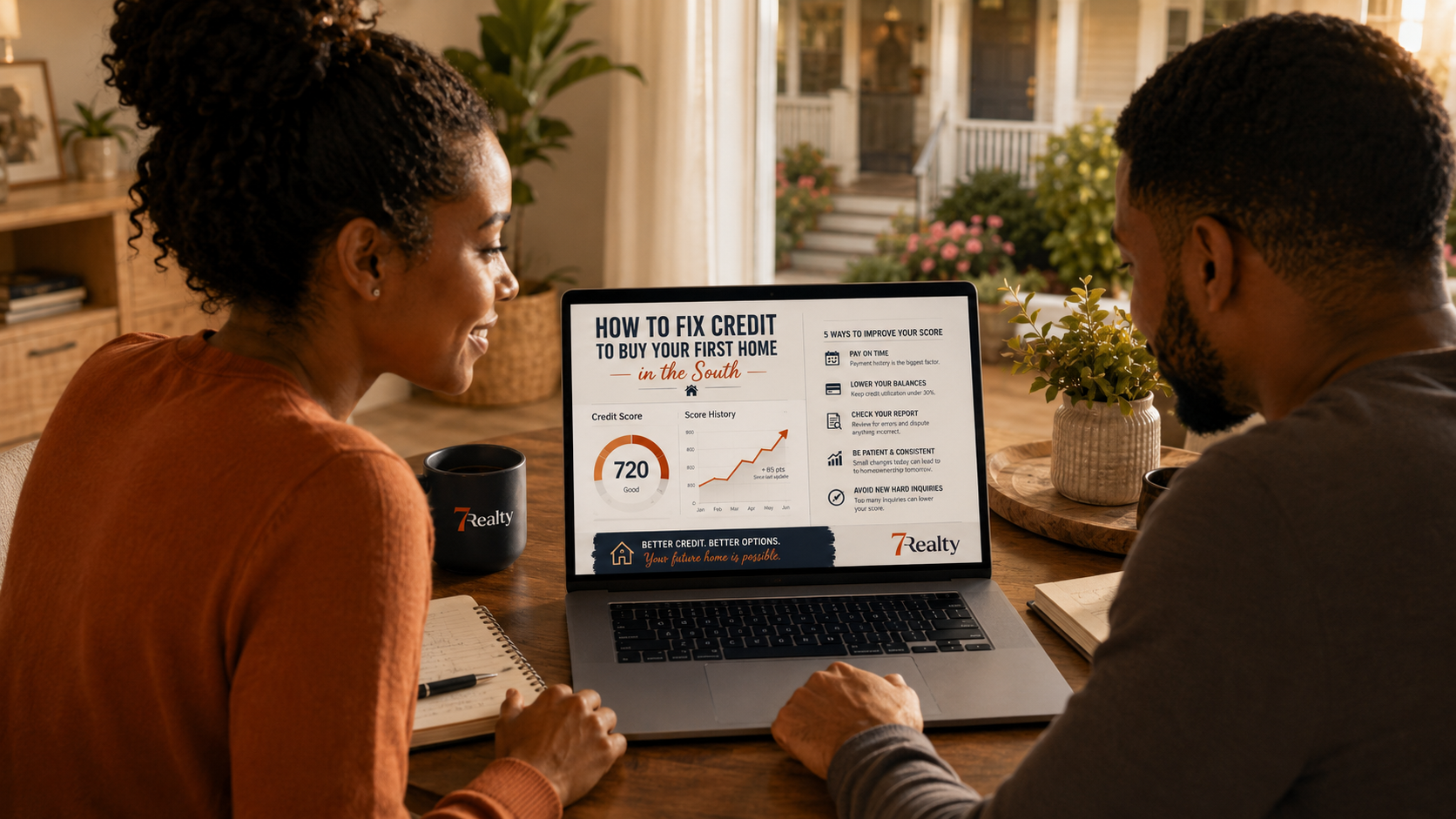
If you have been renting for years, paying your rent on time every month, and still feel like homeownership is somehow out of reach, you are not alone. A lot of first-time buyers in the South are sitting in that exact spot, held back not by a lack of effort but by old collections, a few late payments, or credit card balances that never quite go down. That feeling of being stuck is real, and it makes sense.
But here is what a lot of renters in this situation do not fully realize: you do not need a perfect credit score or a large down payment to start moving toward buying a home. There are loan programs built specifically for buyers with lower scores and limited savings, and there are concrete steps you can take right now to make yourself a stronger candidate for those programs. This article walks you through what is actually hurting your credit, which score milestones matter most for Southern buyers, and what you can do in the next 90 days to get closer to a real mortgage approval.
The Credit Scores That Can Change Your Homebuying Options
Your credit score does not just tell lenders how responsible you are with money. It determines which mortgage programs you can access, how much you need upfront, and what your monthly payment might look like. That difference matters a lot when you are working with a tight budget.
The most commonly discussed benchmark is 580. According to Experian, "the minimum down payment is just 3.5%, as long as your credit score is 580 or higher" for an FHA loan. If your score sits between 500 and 579, you can still pursue an FHA loan, but you will need to put 10% down instead. That shift in down payment requirement is exactly why hitting 580 is worth working toward, even if it takes a few months to get there.
Once your score reaches the low 620s, more options start to open up. Experian notes that with a score above 620, you can typically qualify for a conventional loan, which includes programs like Fannie Mae's HomeReady. HomeReady is designed for lower-to-moderate income buyers and can come with competitive rates and reduced mortgage insurance costs.
For buyers in the South specifically, 640 is a score worth paying close attention to. That threshold matters because it is often the entry point for state-level assistance programs like Georgia Dream and Atlanta's FHLB (usable in all of Georgia). These programs can offer down payment help and below-market interest rates, but they typically require a minimum score of 640 to qualify. Getting to that number is not just about the loan itself. It can also reduce how much cash you need to bring to closing.
Two other paths worth knowing about are USDA and VA loans. USDA loans are designed for buyers purchasing in rural or suburban areas and allow for low or no down payment. VA loans are available to current and former military service members and their spouses, with zero down payment and no mortgage insurance requirement. Eligibility for both programs depends on factors beyond just your credit score, including your location, income, and lender requirements, but they are worth exploring early in your planning process.
Moving from a 560 to a 580, or from a 615 to a 640, might sound like small steps. In practice, those shifts can be the difference between needing a large down payment and qualifying for 3.5 percent down, or between a standard loan and a state-backed program with real financial support behind it.
What to Fix First If You Want Results Fast
Getting every current account paid on time is the single most important step you can take right now. Fresh late payments signal risk to lenders, and even one missed payment from the past few months can raise serious concerns during the underwriting process. Before anything else, bring every open account current and keep it that way consistently.
Once your payments are stable, turn your attention to credit card balances. High utilization is one of the fastest ways to drag a score down, and it is also one of the fastest things you can actually change. A card with an $850 balance on a $1,000 limit is sitting at 85% utilization, and that single card can do more damage than most people expect. Experts advise keeping your use of credit at no more than 30 percent of your total credit limit. On that same $1,000 limit card, your balance should ideally sit at $300 or below. Even getting it down to $500 makes a noticeable difference.
Pulling your credit reports from all three bureaus, Equifax, Experian, and TransUnion, should happen early in this process. You can access them for free at AnnualCreditReport.com. What you are looking for are collections you may have forgotten about, small balances from old phone contracts or utility accounts, and any errors that do not belong to you at all. A $200 medical collection or an old telecom account sitting in collections can quietly hold your score back and delay a mortgage approval much longer than it should.
One thing that catches a lot of buyers off guard is what happens when they try to improve their situation by opening new accounts. Financing new furniture, applying for a store card, or shopping around for personal loans while working toward mortgage readiness can each trigger a hard inquiry and lower your average account age. Both of those things can push your score in the wrong direction at exactly the wrong time. The safest approach is to hold off on any new credit applications until after you have closed on your home.
Working through these steps on your own can feel like a lot, especially if you are not sure which collections to address first or whether a dispute is worth filing. We offer free credit repair for our clients, which means you do not have to figure out the details alone. Having someone in your corner who understands what lenders are actually looking for makes the whole process feel a lot more manageable and keeps you moving forward with a clear plan rather than guessing at what to fix next.
The Four Credit Problems That Hurt Southern Buyers the Most
Payment history carries more weight than most people realize. It is the single largest factor in your credit score, and lenders pay close attention to it when reviewing a mortgage file. A late payment from three or four years ago tends to fade in impact over time, but a missed payment from the last 12 to 24 months is a different story. That kind of recent activity signals to a lender that the pattern may still be ongoing, which makes approval harder and can push your interest rate up even when your score looks acceptable on the surface.
Credit utilization is the second issue that quietly does a lot of damage. Revolving credit utilization could affect around 20% to 30% of your credit score depending on the scoring model, which makes it one of the fastest factors to move in either direction. The tricky part is that making minimum payments every month does not fix a high utilization problem. If your card limit is $1,000 and your balance sits at $900, that 90% utilization is dragging your score down regardless of whether you have never missed a payment.
Collections are the third problem, and this one tends to catch people off guard during the mortgage process. An old phone bill from a carrier you switched away from years ago, a small medical balance that went to a collection agency, or an unpaid balance from a buy now pay later app can all resurface when a lender pulls your full credit report. These accounts do not have to be large to cause problems. A $200 collection can be enough to raise questions or require documentation, and some loan programs require that certain collections be resolved before closing.
Closing old credit cards is the fourth issue, and it is one that people often do with good intentions. The thinking is usually that fewer cards means a cleaner financial picture, but the opposite tends to be true for your score. Keeping credit cards open helps maintain a lower utilization rate because their credit limits add to your overall available credit. Closing an older card also shortens your average account age, which is a separate scoring factor. If a card has no annual fee and a decent limit, keeping it open and barely used is often the smarter move while you are working toward mortgage readiness.
Why So Many Buyers in the South Start Behind
Several Southern states consistently fall below the national average credit score, and that gap is not random. Mississippi, Louisiana, Alabama, Georgia, and South Carolina all show up in data as states where residents carry lower average scores compared to the rest of the country. If you live in one of these states and feel like the credit system is working against you, you are not imagining it.
A lot of this comes down to income and job stability. Rural and Southern communities often have fewer high-paying job opportunities, and many workers deal with seasonal or inconsistent pay. When your income fluctuates month to month, staying on top of every bill becomes genuinely hard. It is not a matter of being careless with money. It is a matter of having less room to work with when an unexpected expense shows up.
That pressure pushes many households toward credit cards just to cover the basics. According to a LendingTree survey, more than half of Americans, 56%, would not be able to cover all of their monthly expenses without charging a credit card, and that number climbs even higher for those making less than $35,000 a year. LendingTree's chief consumer finance analyst Matt Schulz described the cycle of debt as something that is "so hard to break." When credit cards are being used to buy groceries and pay utility bills, balances stay high, utilization climbs, and scores take a hit even when payments are being made.
Buy now pay later services have become another common tool in this pattern. Apps like Afterpay and Klarna can feel like a relief when cash is tight, and they do make it easier to spread out the cost of something you need right now. The problem is that most of these services do not report your on-time payments to the major credit bureaus, which means using them responsibly does nothing to build the kind of credit history that mortgage lenders actually look at. You could spend years paying off buy now pay later plans without gaining a single point toward mortgage readiness.
Carrying high credit card balances and relying on tools that do not build credit history is a financial pattern that has developed across whole communities, not just individual households. Lower wages, fewer financial resources, and limited access to credit education all play a role in why so many Southern buyers are starting the homeownership conversation from a harder position. Recognizing that this is a shared, structural challenge rather than a personal shortcoming matters because it changes how you approach fixing it with the right support and strategy.
The Southern Loan Programs That Make Credit Repair Worth It
Every point you add to your credit score can open up a different set of financing options, and that is where the real motivation to repair your credit comes from. It is not just about a number. It is about what that number lets you do when you are ready to buy.
FHA loans are often the starting point for buyers who are still building toward a stronger score. According to the Consumer Financial Protection Bureau, "for borrowers with lower credit scores or a smaller down payment, FHA loans can often be the cheapest option." With a score of 580, your down payment can be as low as 3.5 percent of the purchase price, which makes it one of the more realistic paths for buyers who do not have tens of thousands saved up. If your score is below 580, some lenders may still work with you, but they will typically require a larger down payment, which is why working toward that 580 benchmark matters so much.
For buyers in rural parts of the South, USDA loans deserve serious attention. If the home you want is in an eligible area and your income falls within the program's limits, you may qualify for 100 percent financing, meaning no down payment at all. Large portions of rural Georgia, Alabama, Mississippi, and Tennessee have USDA-eligible zones, so this is not a niche option for a handful of buyers. It is genuinely one of the most supportive paths available for buyers in smaller communities who are working with limited savings.
Veterans and active-duty military members have access to VA loans, which also offer 0 percent down for those who qualify. The VA loan program does not set a minimum credit score at the federal level, though most lenders have their own requirements. For eligible buyers, this is one of the strongest financing options available regardless of geography.
State-level programs add another layer of support, and this is where hitting a score of 640 can change your situation significantly. Georgia Dream, offered through the Georgia Department of Community Affairs, requires a minimum score of 640 and can provide down payment assistance to qualifying buyers. Tennessee's THDA Great Choice program also requires a 640 score and pairs a 30-year fixed-rate mortgage with down payment help for first-time buyers. These programs are designed to support buyers who are working hard but still need a hand with upfront costs.
Reaching 640 does not just mean you qualify for more programs. It often means you qualify for more assistance, better terms, and less money out of pocket at closing. Working toward a stronger credit profile is one of the most practical financial decisions you can make before you ever start touring homes.
A Realistic 90 Day Plan to Move Closer to Preapproval
Start with your credit reports, not your wish list. Pull all three reports from Equifax, Experian, and TransUnion through AnnualCreditReport.com and identify the two or three issues doing the most damage. Trying to fix everything at once tends to lead to burnout and wasted energy, so focus on the problems that are clearly affecting your score the most and work those first.
From there, here is a practical breakdown of how to approach the next 90 days:
- Month one should focus on getting every current account paid on time and bringing any past-due balances current. After that, turn your attention to revolving balances. Paying down credit card debt tends to show up in your score faster than almost anything else, which makes it one of the most practical moves you can make in a short window.
- Month two is when collections need attention. Paying off an old collection without understanding how it will be reported can sometimes backfire, so get guidance from a professional before you send any payments. While working through this, protect what you already have. The CFPB notes that "applying for a credit card, car loan, or other type of loan" during this period can lower your scores, so hold off on any new applications. Keep older no-fee accounts open to protect your credit history and available credit.
- Month three is when you take a serious look at which loan programs you might actually qualify for. Your score, income, and location all factor into this. If you live in a rural part of the South, USDA financing may be worth exploring. FHA remains one of the most accessible paths for buyers working toward a 580 score. Veterans and active-duty service members should look at VA options. Many counties and states also have local down payment assistance tied to income limits, so do not assume you have to come up with everything on your own.
Sitting down with a trusted lender or a HUD-approved housing counselor before the 90 days are up can change the way you see your own progress. They can review your actual file, tell you exactly which score milestone to target, and help you match your credit repair steps to a specific loan goal. That conversation turns a general plan into a real one with a finish line you can actually see.
The Steps That Actually Move You Forward
Nobody gets to homeownership by fixing everything at once, and that is actually good news. The steps that matter most are manageable ones. Getting current on your bills, bringing credit card balances down, and working toward the score targets that open real doors are all things you can start doing this week.
A 580 gets you into FHA territory with 3.5 percent down. A 620 starts opening conventional options like HomeReady. A 640 can put state programs like Georgia Dream and Tennessee's THDA Great Choice within reach, along with the down payment assistance that comes with them. If you qualify for USDA or VA, you may not need a down payment at all.
The credit challenges many Southern buyers face are not unique to any one person. Mississippi, Louisiana, Alabama, Georgia, and South Carolina all show up in the data as states where residents carry lower average scores, and a lot of that comes down to income pressure, inconsistent pay, and having to rely on credit cards just to get through the month. That context matters because it means the difficulty you are facing is real, but so are the paths forward.
Your credit score responds to what you do next. Pull your reports from AnnualCreditReport.com, find the two or three things doing the most damage, and start there. Every responsible financial decision you make from this point forward is building toward something real, and each one brings you closer to the preapproval, the lower down payment, and the home that has been waiting for you.
Check out this article next